
At about the size and weight of a pygmy shrew, the stag beetle, Lucanus cervus, has few rivals for the title of Europe’s biggest beetle. From the tip of their antlers to the base of their abdomen, males can be almost 7cm (3 inches) long and, for stag beetles, it can pay to be big.
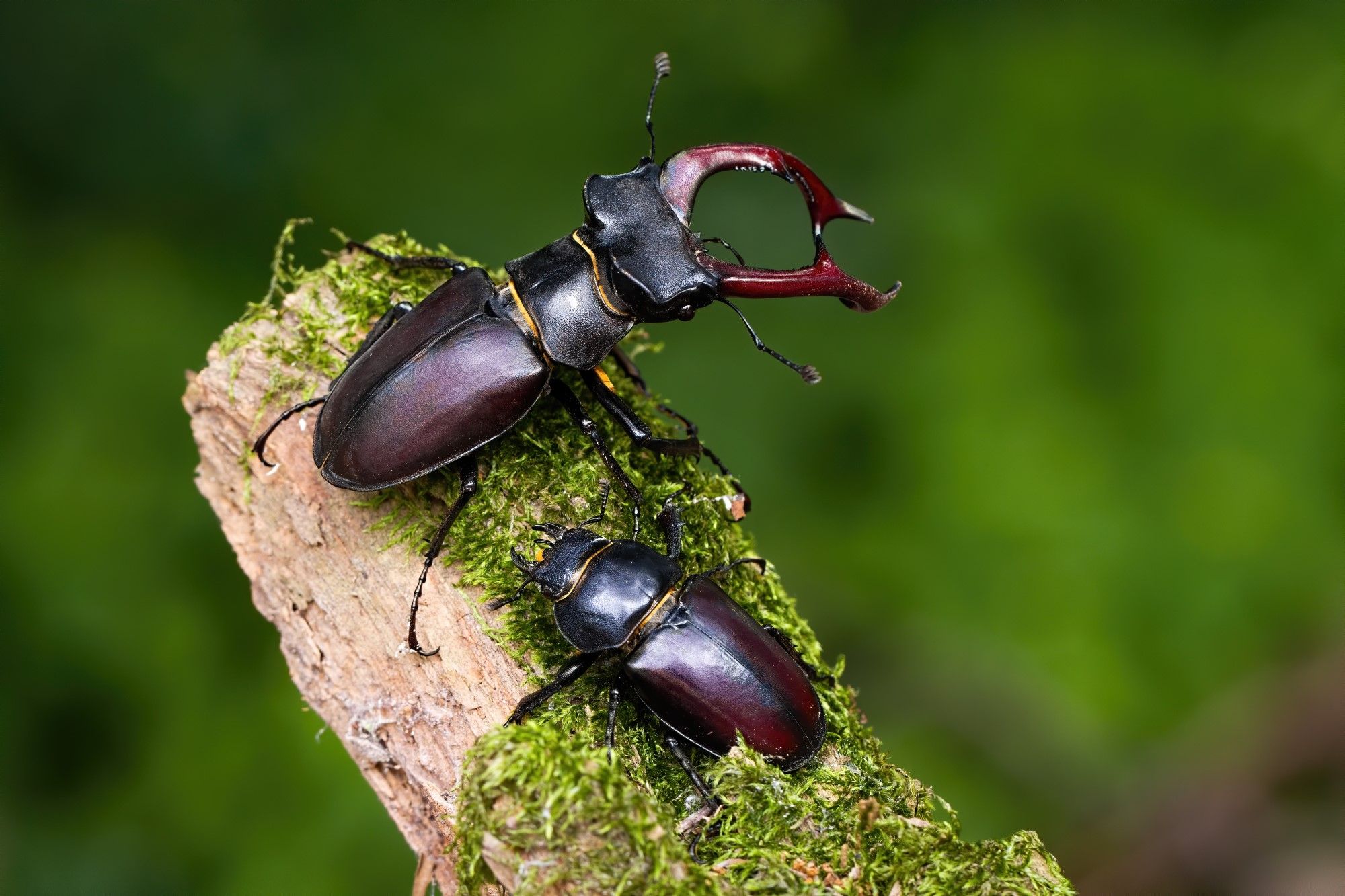
Stag beetles Lucanis cervus are found across central and southern Europe, from Portugal to Kazakhstan. In Great Britain they’re scarce except for parts of southern England.
Both males and females have ‘antlers’ – actually, oversized, pincer-like jaws – but in males, they’re particularly big. Males compete with one another for the attentions of females, grappling and using their antlers to upend rivals. Larger individuals win more fights and secure more mates.
But, while size is related to reproductive success in male stag beetles, it’s not the whole story. Smaller males employ an alternative tactic. While bigger males are typically better brawlers, smaller ones are more agile fliers, giving them an advantage in the pursuit of females. Squadrons of males fly in concentric circles, two or three metres across. When a flying female approaches, the race is on to grab her. When one does, the couple fall to the ground, and the ardent suitor carries the female off to a more secluded spot – away from interfering rivals. These aerial encounters are more often won by smaller males.
Such battles and romantic liaisons last just a few summer months: by September, most of the adults have died, exhausted, sometimes prey to corvids such as magpies.
But that isn’t the end of the story. While the adult beetles might be the main draw, the business end of the stag beetle life cycle is going on elsewhere. The really impressive stuff is largely unseen…
Stag beetles are beneficial composters
To be as big as a stag beetle, you need a healthy appetite, and stag beetle larvae spend the first three to five years of their lives bulking up on dead wood. After mating, females go in search of rotting wood, sniffing out an old tree stump or rotten fence post, and burrow into the soil to lay 20 to 30 individual eggs. Over the next few years, the larvae develop into large, creamy-white grubs with orange heads and brown jaws that chomp on rotting wood, recycling nutrients and improving the soil quality.
The larvae will moult several times, reaching a length of 8cm. It might take up to five years, but early one summer they begin the process of pupation, building a subterranean cocoon from soil and pieces of wood, glued together with saliva. Inside, the larvae transform into adult beetles, emerging from their chambers in September, just as the action above is coming to an end. So, they wait and overwinter until May when they burrow up to the surface to see one last summer.
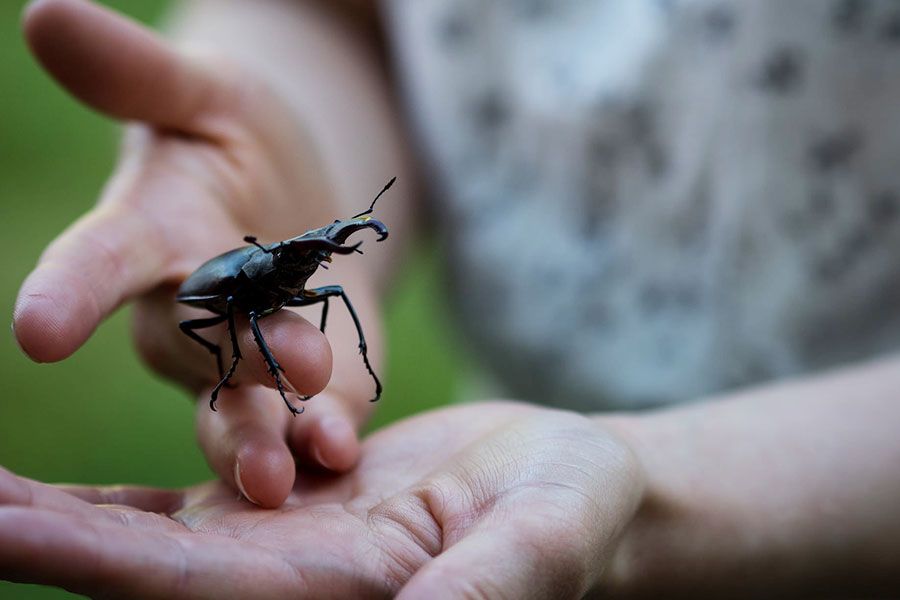
For all their size and impressive jaws, stag beetles (almost) never bite people. Flight muscles need to warm-up and adult beetles will bask on sunbaked brick or tarmac surfaces, often putting themselves in the line of cars or pedestrians’ feet on roads and pavements. If you find one in such a spot, gently pick it up in the palm of your hand and put it somewhere less exposed.
These miniature titans live spectacular lives, hidden in the soil or thrumming through the air on a still summer’s evening. But, like all of us, they could do with a little help from time to time.
Take part in our long-running survey, Great Stag Hunt, and report when you see an adult stag beetle or a larva:
Different mating strategies of male stag beetles are described in the scientific report: Giannetti, D., Schifani, E., Rolli, E., Fior, E., Pasquali, B., Campanaro, A., & Grasso, D. A. (2024). Fight or flight alternative mating tactics may explain the iconic male polymorphism of the European stag beetle. Scientific Reports, 14(1), 24758, available to read here.
Image credits: WildMedia|Shutterstock, Roland Vogt Achkarren Baden Wurttemberg
12th May, 2026