
In 1997, stag beetles (more formally, greater or European stag beetles, Lucanus cervus) were made a ‘priority species’ in the then UK Biodiversity Action Plan. There was evidence to suggest populations were declining in continental Europe and, in some parts of their range, becoming extinct, but little was known, at least nationally, about the stag beetle population here.
So, a year later, PTES launched the Great Stag Hunt, asking people to send in records of stag beetle sightings. Over 9,000 were reported. The survey was repeated four years later and again in 2006 and, since 2015, it’s run annually, collecting around 100,000 records to date.
Population changes
So, what have the data collected in the Great stag Hunt told us about how British stag beetle numbers are changing? The findings of a study using the data were published in March this year, in the journal Insect Conservation and Diversity.
The first question the study asked was, has the distribution of stag beetles changed over time? Ideally, to answer this, you’d look for stag beetles in every square of the Ordnance Survey map of Great Britain, surveying each square with the same effort, and do the whole thing again every year. But that’s easier said than done. Instead, you can ask, does the distribution of stag beetle sightings change? That’s a similar question, but not quite the same thing.
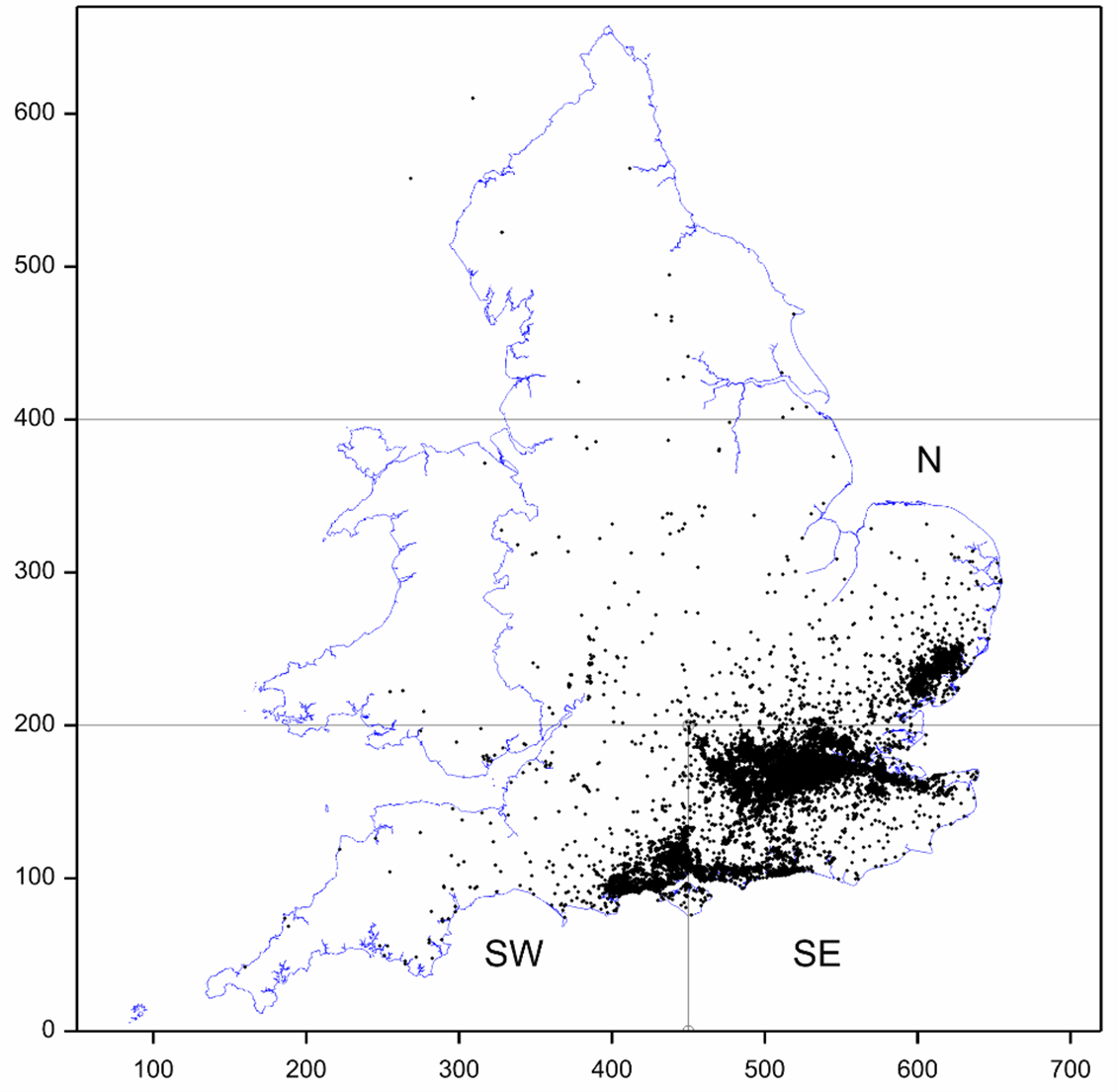
The distribution of Great Stag Hunt records between 1998 and 2022. The axes show easting and northing values, and the north, southwest and southeast regions used in the analysis are also shown.
The distribution of records indicates where there are stag beetles and people to record them – it doesn’t necessarily show where stag beetles are absent. That said, the distribution of people hasn’t changed very much since 1998 and by taking an equal number of randomly selected records from each year, you can account for differences in survey effort. Comparing the distribution of records in two periods twenty years apart, 1998–2002 and 2018–2022, the study found a similar distribution, but the percentage of map squares in which stag beetles were found, in the southwest of their range had almost halved in the later period.
Surveys and historical collections
To look back even further, the study also mapped hundreds of historical specimens from museum collections in Liverpool, Manchester, Cambridge and elsewhere, that were collected between 1829 and 2022. Half of the museum records dated from before 1950. When these were compared with the Great Stag Hunt records, their distributions were very similar: most of the museum records lay within the core range described by the survey records, with only a few lying outside of these areas.
The picture is one of a largely stable stag beetle population over the last 25 years, and going back perhaps more than a century, but one that has become scarcer in the southwest of its range in southern England.
While the core range of stag beetles hasn’t changed very much, can we say the same about the number of stag beetles, about their abundance? The Great Stag Hunt doesn’t record systematic counts of beetles. Most of the time, records are of a single beetle, but occasionally two or more are spotted at the same time and multiple sightings are recorded.
The study looked at the average number of stag beetles recorded at one time. This was highest in the north of their range and lowest in the southeast, with the average for the southwest, in the middle. All three regions however showed the same decline over time: the average number of beetles recorded at the same time fell by a tenth between 1998 and 2022. Together with the decline in the proportion of sites reporting stag beetles in the southwest, this suggests the population could be getting smaller.
Stag beetles appear to be hanging on in the UK, but for how long? Key to their survival is a plentiful supply of dead wood in the soil that the larvae can feed on. Retaining and creating deadwood habitats – leaving tree stumps in the ground or building log piles – might secure a future for stag beetles and can be on a scale to fit any-sized garden.
In the next stag beetle blog: The wonders of dead wood in all its shapes and sizes!
The Great Stag Hunt continues this year, so if you see a stag beetle, please record it!
Image credits (top to bottom): Lucy Page, Henrik Larsson | shutterstock.com,