
Over 25 years of citizen science data provide exceptional resource for flagship species
Data from a long-running citizen science survey is being used in the first ever national analysis of stag beetle population distribution in the UK. An astonishing 82,883 records submitted to the Great Stag Hunt, run by People’s Trust for Endangered Species (PTES) have been collected since 1998. Conservation scientists from PTES have analysed these alongside historical museum collection data to identify potential population distribution changes for this impressive and much-loved species, the largest beetle species in Europe. The results will be important in directing future conservation efforts for stag beetles in the UK and have just been published – with open access – in the journal Insect Conservation and Diversity.
The results show a broadly stable distribution of stag beetles in the UK, although the data indicate a recent decline in the southwestern part of the species’ range and it is not clear why this is the case. There are also indications that in recent years, the abundance of adult stag beetles has decreased, as average counts of multiple beetles seen at one time have declined over the years. This leaves no room for complacency in implementing conservation management actions for this flagship species. Our understanding is further complicated by the fact that, while we have a solid understanding on their distribution, there isn’t a robust dataset on actual numbers of adult beetles and larvae, a difficult task for invertebrates.
The Great Stag Hunt dataset is already an impressively long length but with the support of a research intern at PTES and the Natural History Museum, it has been possible to undertake a comparison with historical data from seven museum collections as well, some of which date back over 100 years. The result is the creation of a comprehensive and long-running data series, particularly useful for invertebrate species where such data are often scarcer. Tracking invertebrate populations is challenging, but with the public’s help, conservationists can now target their efforts more effectively. The study also underlines how valuable historical museum records remain for modern scientific research.
David Wembridge, Conservation Research and Strategy Officer at People’s Trust for Endangered Species and lead author of the paper, explains: “Stag beetles are extraordinary insects, spending most of their lives – three to five years – as larvae underground before emerging as adults in spring. Unfortunately, they might be under threat due to the loss of deadwood habitats in gardens, parks, and woodlands, which the larvae feed on, recycling nutrients into the soil; and in urban areas where they are vulnerable to traffic and footfall as they bask on warm tarmac surfaces. This research underlines the importance of making space for stag beetles and other wildlife in our towns and cities as well as in more rural environments.”
Dr Silviu Petrovan, Conservation Research and Strategy Manager at People’s Trust for Endangered Species and senior author of the paper added: “This research shows the importance of the public’s enthusiasm for citizen science data in supporting UK conservation efforts. Without their observations for the Great Stag Hunt project over the last 27 years, we would not have had this clear information on the distribution of stag beetles in the UK. Coupled with the historical data from the Natural History Museum and other collections, we also now have a longer 100-year view which indicates populations are relatively stable, which is good news for this flagship species and helps track progress towards the government’s biodiversity targets.
“However, we cannot be complacent as there are some suggestions that the number of adults might in fact be declining and a locally common species can decline substantially without their distribution changing that much. We know the overall population is under threat through habitat degradation and loss but understanding trends in invertebrate populations is challenging, particularly for a species with such a broad range as the stag beetle. Although we don’t have all the pieces of the jigsaw yet, it is important to put measures in place now to ensure stag beetles are protected and supported and with them, a wider community of insects that depend on dead wood habitat.”
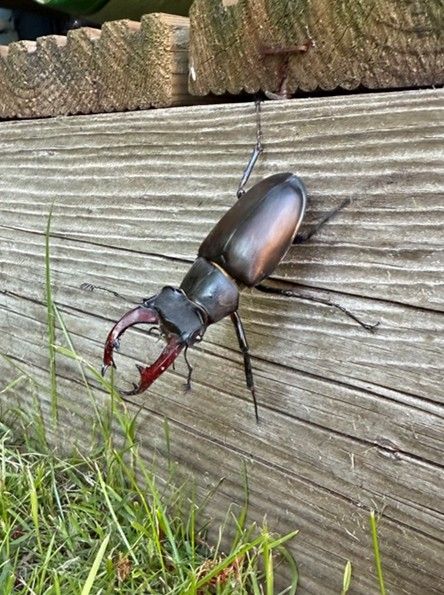
Stag beetles are often found in urban and suburban gardens and parks, as well as woodland edges and the wider countryside. They’re also often spotted basking on sunlit walls and warm tarmac surfaces, while their larvae (large white grubs) are found underground, among the roots of old tree stumps. Males are instantly recognisable with their distinctive antler-like jaws and are often seen flying on warm, still evenings in summer in search of females, which are slightly smaller and lack the impressive ‘antlers’. Stag beetles are mostly found in southern England (except the chalky soils of the North and South Downs), but there are hotspots in the Severn Valley and in coastal parts of the South West.
To find out more, visit https://stagbeetles.ptes.org/.
– ENDS –
For high-res high-res images and footage, or to arrange interviews, contact:
Alison Byard, Culture Communications Collective, alison@culturecommscollective.com 07773 769915
Morag Wood, Culture Communications Collective, morag@culturecommscollective.com 07976 081044
Notes to editors
About the paper
- Title: Long-term population changes for the UK stag beetle Lucanus cervus — evidence from citizen science surveys and museum collections
- Authors: David E. Wembridge, Steve D Langton, Freya Read, Laura M Bower, Maxwell V L Barclay and Silviu O Petrovan
- First published in Insect Conservation and Diversity, 19 September 2025 https://resjournals.onlinelibrary.wiley.com/doi/10.1111/icad.70022.
Available for interview
- David Wembridge, Conservation Research and Strategy Officer, People’s Trust for Endangered Species, who runs the Great Stag Hunt and lead author of the paper.
- Dr Silviu Petrovan, Conservation Research and Strategy Manager, People’s Trust for Endangered Species and senior author of the paper.
About People’s Trust for Endangered Species (PTES)
- PTES, a UK conservation charity created in 1977, is ensuring a future for endangered species throughout the world. We protect some of our most threatened wildlife species and habitats, and provide practical conservation support through research, grant-aid, educational programmes, wildlife surveys, publications and public events.
- PTES’ current priority species and habitats include hazel dormice, hedgehogs, water voles, noble chafers, stag beetles, traditional orchards, native woodlands, wood pasture and parkland and hedgerows.
- Visit www.ptes.org and follow PTES on Facebook, Bluesky, Instagram, YouTube and LinkedIn.