
We have long thought that one of the drivers of the declining dormouse population in the UK is related to the number of litters that are produced in spring. Adult female dormice that have litters in May or June are not only able to have at least one further litter in the same year, but their offspring – the young of year – from those early litters, can also reach sexual maturity in the year of their birth and produce litters of their own.
Are fewer dormice litters cause for concern?
We can use data from the National Dormouse Monitoring Programme (NDMP) to look at the maximal number of litters recorded in either May or June per 50 boxes and the results can be seen in the graph below.
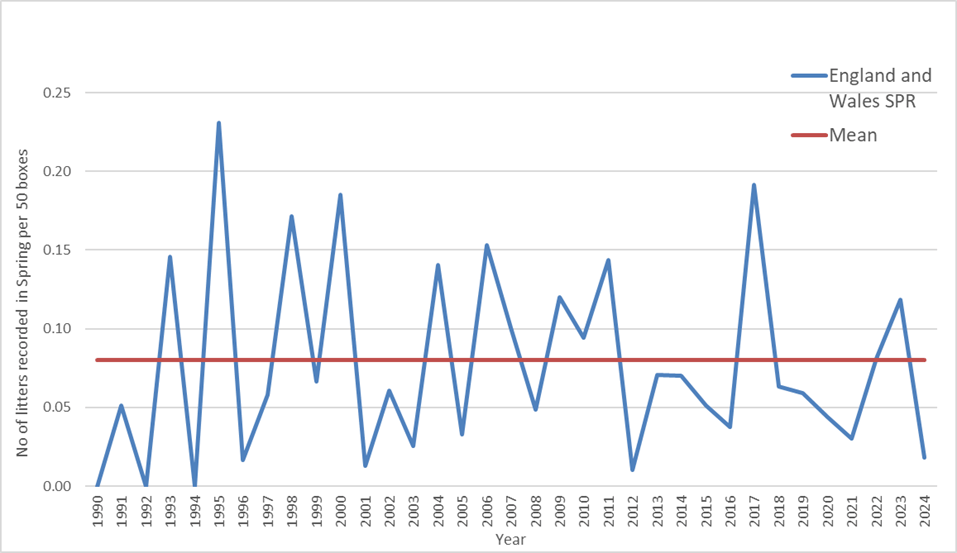
The maximal number of dormouse litters recorded in spring (may or June) per 50 nest boxes from 1990-2024.
Prior to the year 2000, the trend appeared to be cyclical with years alternating between those where more litters were recorded than the average, followed by a year where less litters were recorded than average. But since the year 2000 there have been periods where, for three or four consecutive years, fewer litters were recorded than the long-term average and this may be cause for concern.
In addition, hibernal survival will also impact the dormouse population. This is something we can investigate using NDMP data. If we look at the number of mature dormice (juveniles and adults) recorded in boxes in the autumn and compare it with the number of mature dormice recorded the following spring, we can get an indication of overwinter survival. The data are shown in the graph below. The indication from the data is that between 40% and 70% of dormice die during hibernation.
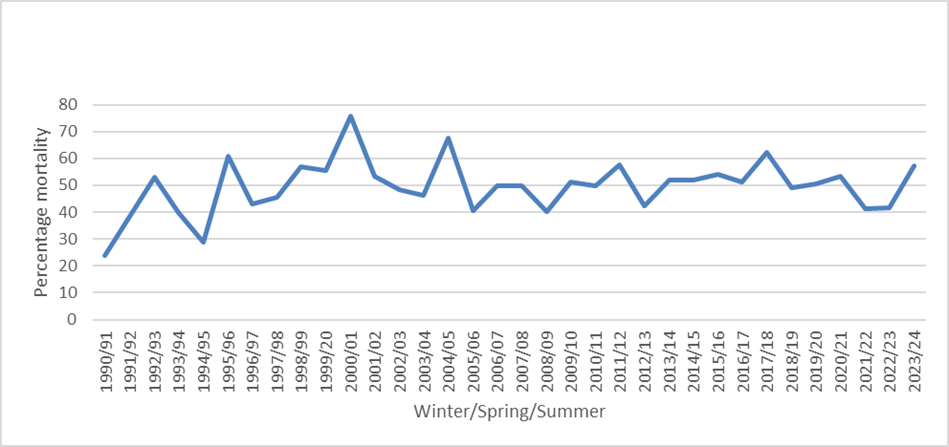
Hibernal mortality of dormice in the UK estimated by comparing the number of mature dormice recorded per 50 nest boxes in autumn with the number recorded the following spring from 1990-2024.
How did the dormouse population fare last year?
If we consider the two indicators discussed above, how did our dormouse population fare last year? From a dormouse perspective, during 2024-25 the weather was relatively kind to them. The Met. Office reported that:
- The winter of 2024 was milder than average overall, but very variable with cold, wintry spells in early December and mid-January, contrasting with much milder, wetter, unsettled and occasionally stormy weather at other times.
- Spring 2025 was mainly dry and settled with high pressure dominating for most of the season. It was provisionally the warmest and sunniest spring on record for the UK as a whole.
- Summer 2025 was the warmest UK summer on record with overall rainfall below average.
Perhaps the winter wasn’t ideal for dormice considering how variable it was, but the spring and summer were both dry. This may have led to one of our more productive fruiting seasons for our native trees and shrubs.
Hibernal survival in 2024/25 appeared to one of the best we have seen since 1990/91 and 1994/95 with only 31% of the population dying overwinter. This may have led to a very productive spring with a high number of spring litters recorded. There does appear to be a link between hibernal survival and the number of spring litters recorded. This, in turn, could result in an increase in the number of mature dormice recorded in the autumn (see table below).
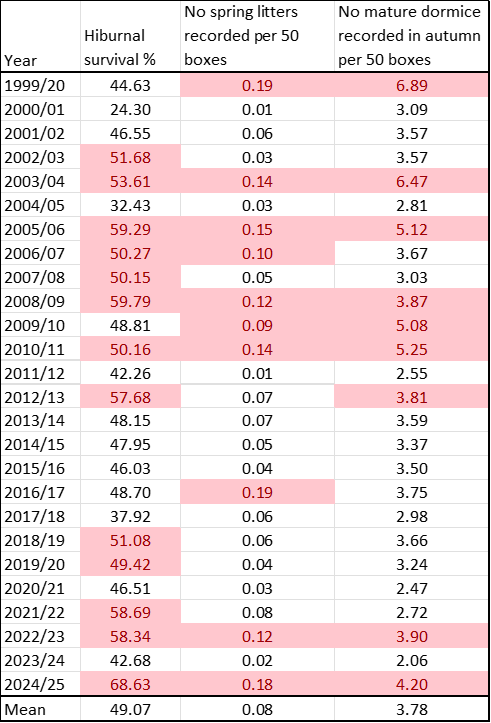
Hibernal survival of dormice in the UK with highlighted figures showing survival greater than the mean. The number of dormouse litters recorded in spring per 50 boxes is shown and the number of mature dormice recorded in autumn. Highlighted figures show if the number of dormice recorded are above the mean.
So, was 2025 a good year for dormice?
It appears that it was. Hopefully the wet weather we have had in the earlier part of 2026 won’t have knocked the population back again. But there is more interesting, good news. Since 1990, only 252 dormice have been found in 45,730 boxes checked in March; that’s one dormouse per 180 boxes checked. But this year, one site has already reported seeing 11 dormice in March in 75 boxes, and six dormice were recorded in a Nottinghamshire woodland. Are dormice adapting to a changing climate or are some of the consequences not as bad as we feared they might be? Only time – and data – will tell.
8th April, 2026
Image credit: Megan Gimber