
Surveying dormice in different habitats
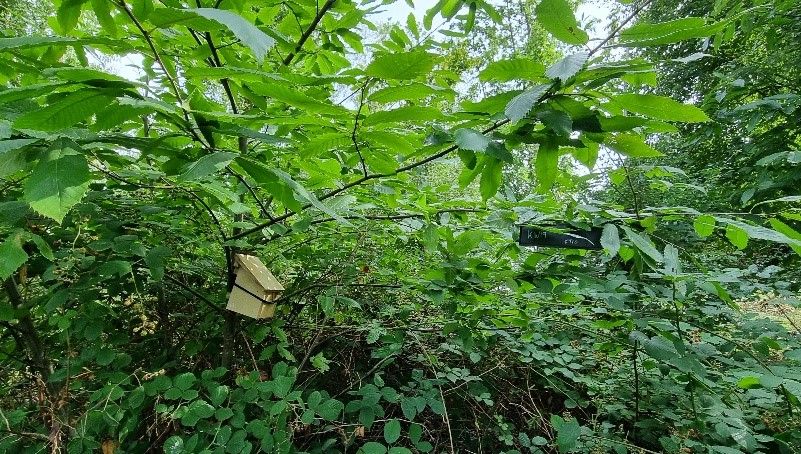
It has long been thought that nest tubes were the best way of surveying for dormice in any habitat, and that nest boxes were the best way of monitoring populations. Recent work, however, indicates that footprint tunnels are the most efficient method to detect dormice in any habitat type, while nest tubes seem to work better in scrubby habitats and hedges, and nest boxes are more likely to be used by dormice in unmanaged woodland and mid to long rotation coppice. A disturbance licence is needed to check nest boxes and nest tubes, but no licence is required to check footprint tunnels.
There are standardised survey methodologies using footprint tunnels and nest tubes that give a high confidence in the likelihood of dormouse absence, if no evidence of dormice is found during the survey. While a high likelihood of absence of dormouse is important for ecological consultants, it is less critical for conservation projects which means it’s possible to reduce the level of survey effort required to make the survey techniques more appropriate to the habitat with the aim of detecting dormice if present. But it means that where no evidence is found it doesn’t mean that dormice are absent.
Surveys should be carried out in the dormouse active season (May – Oct) and there will be a greater, and quicker, chance of detection if the survey is conducted later in the season.
The following levels of survey effort are suggested:
|
Habitat |
Nest boxes |
Nest tubes |
Footprint tunnels |
Survey effort |
Duration |
|
Unmanaged woodland |
10 |
|
15 |
Visit every two weeks |
Max six weeks or when evidence of dormice is recorded |
|
Managed woodland |
5 |
5 |
10 |
Visit every two weeks |
Max six weeks or when evidence of dormice is recorded |
|
Hedge or linear scrub |
|
5 |
5 |
Visit every two weeks |
Max six weeks or when evidence of dormice is recorded |
Monitoring dormice in a landscape and at a site
Dormouse nest boxes have been the standard way of monitoring dormouse populations for the last 30 years and form the basis of the NDMP. However, nest boxes don’t appear to work well in hedges and scrub. If dormice were monitored in these habitats using nest tubes, it is likely that the tubes would quickly be subsumed by the growing vegetation. Nest tubes are also flimsier than boxes and more likely to break down more quickly. Footprint tunnels can detect dormice more quickly in hedges and scrub habitats, but they give no indication of dormouse population sizes. But determining dormouse presence should be adequate for most situations, and if the survey can be repeated every three to five years, it will demonstrate persistent dormouse presence or otherwise.
Monitoring a landscape
- Identify the monads (1km2) within the landscape. Determine those monads highly unlikely to be occupied by dormice (i.e. water features for example).
- Identify existing records (either from the NDMP, NDD and/or LRC records).
- Set the parameters of what you can achieve annually in terms of time, volunteer capacity etc. to undertake a minimum number of ‘reduced effort surveys’ (as described above) and identify which monads to target. If you don’t survey adjacent monads, you will generally be demonstrating dormouse presence/possible absence in tetrads (2km2).
- If possible, repeat annually, to build up a better picture of dormouse distribution across the landscape. Data from NDMP sites provide annual evidence of presence and surveys repeated in non-NDMP monads every three-five years can provide evidence on persistence.
Monitoring sites
- Identify the hectares within the site boundary, aligned to the national grid.
- If it’s an NDMP woodland, identify the hectares with boxes and where evidence of dormice has recently been recorded (if any of these areas are managed/coppiced the boxes should be moved to areas of similar habitat).
- Determine those hectares highly unlikely to be occupied by dormice i.e. water features for example, and those adjacent to hectares where dormice are known to be present.
- Set the parameters of what you can achieve annually in terms of time, volunteer capacity etc. to undertake a minimum number of ‘reduced effort surveys’ (as described above) and identify which hectares/habitat you would like to target.
- If possible, repeat annually, to build up a better picture of dormouse distribution across the site. Aim to repeat surveys in non-NDMP hectares after three-five years to demonstrate persistence or otherwise.
At present there is no way to report your results using this type of survey, but we will correct that over the next few weeks. In the meantime, if you have any results, either positive or negative please let us know by email Ian.white@ptes.org