
Thanks to your support, PTES is funding pioneering work in India to save two of the world’s rarest primates: golden langurs and western hoolock gibbons. Roads and deforestation have fragmented their forest homes, leaving them at risk of road collisions, isolation, and extinction. But our newest Conservation Partner, Dr Jihosuo Biswas, is leading a team trialling innovative solutions, including canopy bridges and community planting, and they’re already transforming the future for these threatened species.
Golden langurs
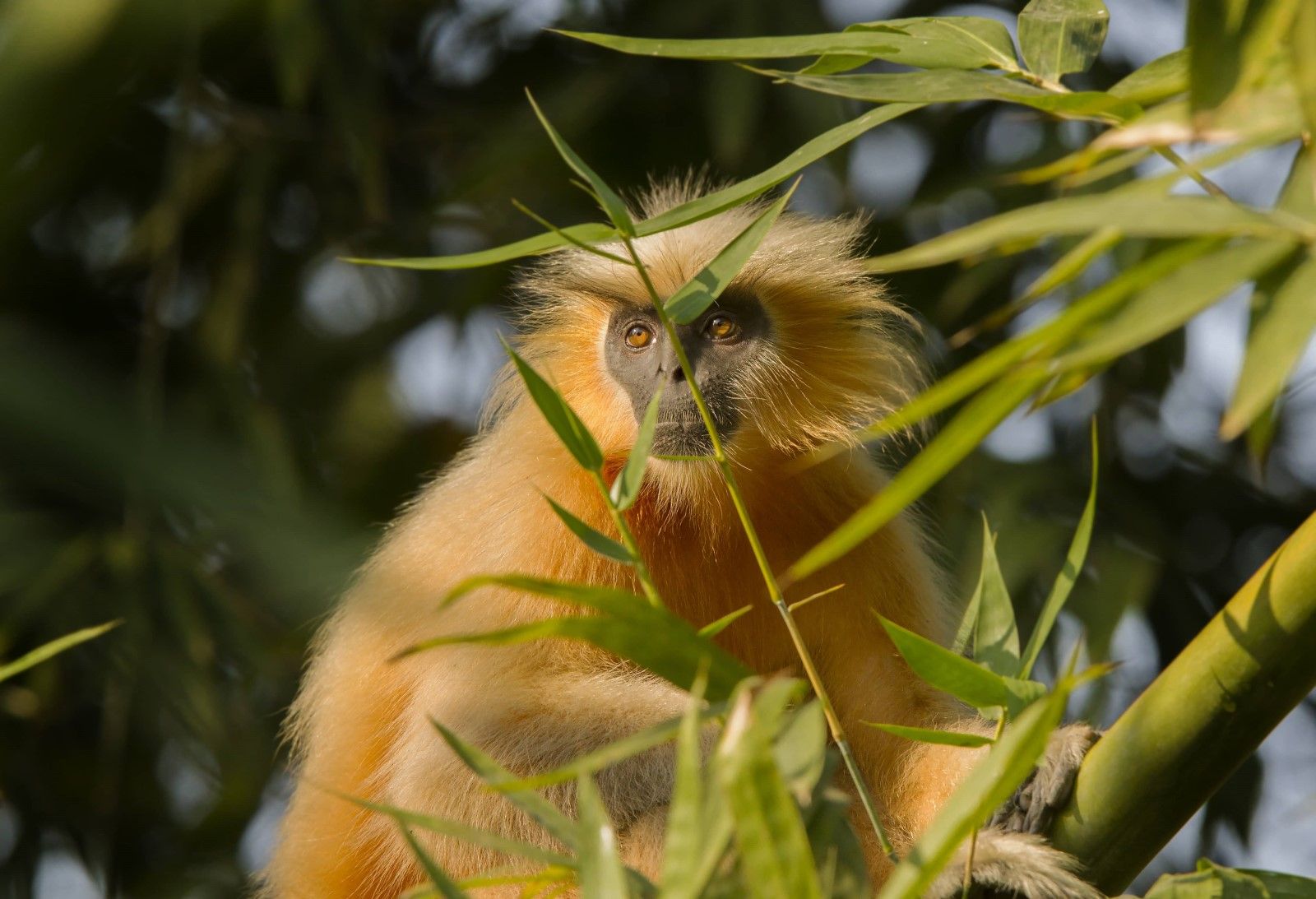
Golden langurs are found in the Assam region in Northeastern India and in southern Bhutan and are considered sacred by Himalayan people. With their flowing coats and black faces, golden langurs are one of the world’s most striking and beautiful monkeys, but with fewer than 10,000 individuals left in the world, they’re close to extinction. Sadly, habitat loss is severely threatening them. The Assam region has lost almost one half of its forest in the last few decades. The remaining populations of golden langurs now exist in isolated pockets of forest, and must travel across farmland, villages and roads to find food and mates. Their numbers in Bhutan have also declined in the past three decades.
With PTES’ support, Jihosuo and his team installed eighteen artificial canopy bridges to reconnect fragmented forest. Over the past year, these bridges were used by golden langurs 133 times, reducing road collisions at a known hotspot by 74%. Of the four designs tested (ladder, pipe, bamboo, and rope), langurs showed a clear preference: 71% of crossings were on pipe bridges. This work has just been published in the Journal of Wildlife Science.
The Assam Government has now endorsed these designs, installing similar structures across the state to protect primates and other wildlife. And in Bhutan, Jihosuo’s training has already led to two new bridges being built, with langurs using them within days.
Growing green corridors
In the last year the team has helped the local community plant 2,000 saplings (predominantly rubber and areca nut trees, along with other commercial wood species) to restore a green corridor linking Chakrashila Wildlife Sanctuary with Buxamara Reserve Forest through village backyards. This initiative not only strengthens ecological connectivity (providing golden langurs with safe passage) but also integrates community support by promoting sustainable livelihoods and providing incentives for corridor maintenance and conflict mitigation.
Western hoolock gibbons

Western hoolock gibbons are an endangered lesser ape found across Asia, though 70% of the Indian population is in Assam. They are threatened with habitat loss and hunting throughout their range. In Assam the population has dramatically declined by 90% in recent years.
Jihosuo is working to develop canopy bridges that are tailored for hoolock gibbons and other primate species in the newly created Dehing Patkai National Park. Unlike other arboreal primates such as langurs and macaques, gibbons are brachiators – moving acrobatically through the trees by swinging from branch to branch using their exceptionally long arms. This means bridges for hoolock gibbons require specific design modifications, distinct from those designed for golden langurs. To date, twenty-two canopy bridges are under construction, and two camera traps have been installed to monitor their effectiveness. Initial monitoring has already confirmed the bridges have been used by Assamese macaques, common palm civets, and hoary-bellied squirrels – an encouraging sign of success.

A capacity-building workshop was organized and run at the national park for frontline staff, researchers, and community volunteers to train them on population estimation and monitoring techniques for hoolock gibbons. Participants were also trained in various survey methodologies, data recording, using equipment like GPS, wireless devices and Geo Tracker maps, to ensure accurate data collection. After the workshop, the staff and community volunteers carried out a systematic survey to estimate the population. Almost 430 hoolock gibbons were spotted in 148 family groups. Using these observations and including additional evidence from the gibbons’ distinctive calls, the team estimated that at least 612 gibbons are living in the national park.
Looking ahead
In the coming year, Jihosuo and his team will continue to maintain canopy bridges, monitor primate populations, and work with communities to restore forest corridors. Thanks to PTES supporters, this pioneering project is not only keeping rare primates safe today, but also reconnecting entire ecosystems for the future.
Image credits shutterstock.com
January 6th, 2026